
Peptides Explained: Why These Small Molecules Are Getting So Much Attention
A simple guide to what peptides are, how they work, and why researchers are studying them more than ever

Over the past decade, peptides have gone from being a niche topic in biochemistry labs to one of the most talked-about subjects in modern biomedical research.
You’ll see them mentioned in discussions about metabolism, recovery science, longevity research, muscle biology, gut health, and even cognitive performance.
But despite all the attention, many people still ask the same basic question:
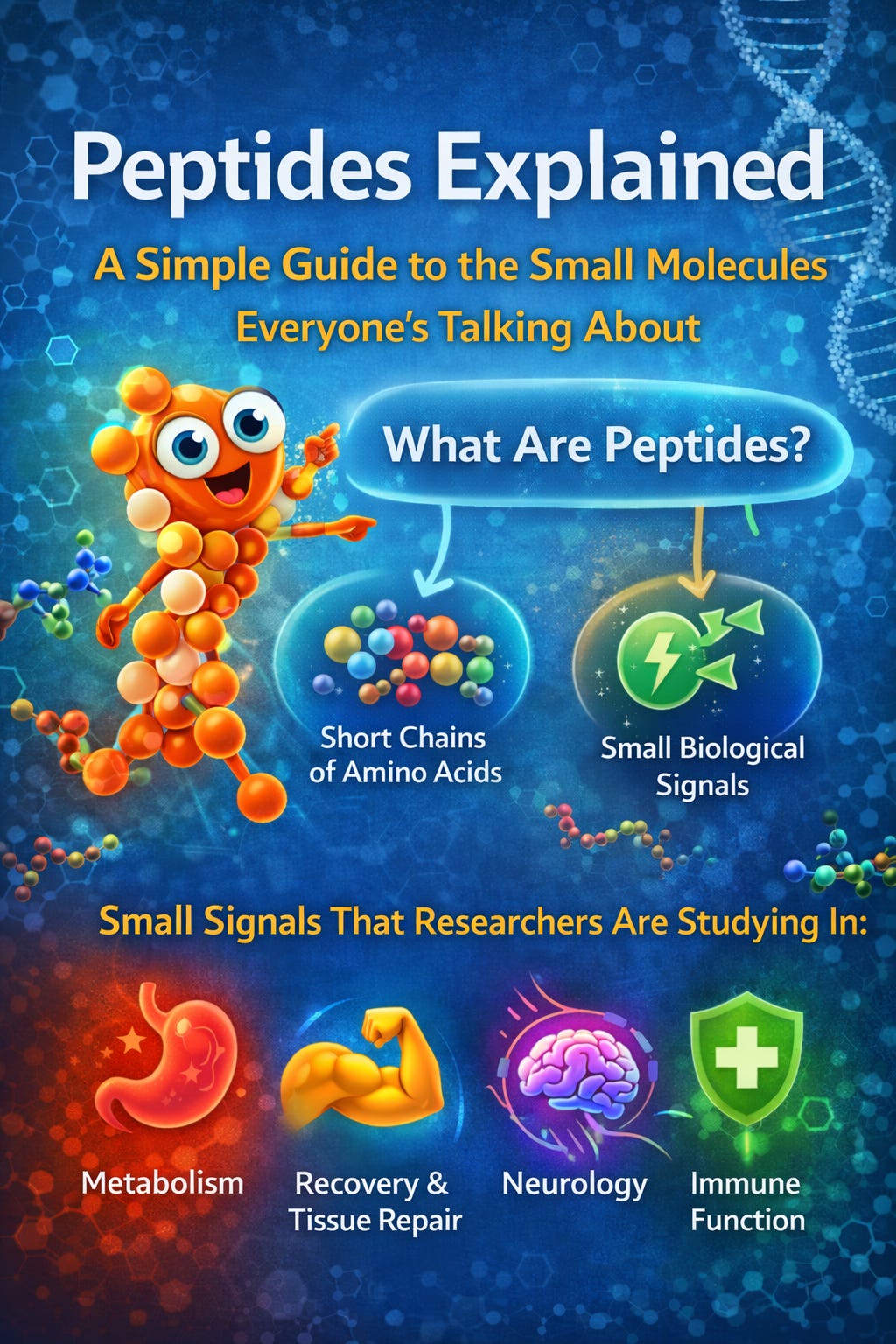
What exactly are peptides?
Understanding peptides isn’t as complicated as it might sound. In fact, they’re one of the most fundamental building blocks in biology.
What Are Peptides?
At their simplest level, peptides are short chains of amino acids.
Amino acids are the same molecules that make up proteins. The difference is mainly size:
• Peptides are shorter chains of amino acids
• Proteins are longer and more complex chains
These amino acids are linked together by peptide bonds, forming small signaling molecules that the body uses to regulate a wide range of biological processes.
Because they are smaller than full proteins, peptides often act as messengers in the body.
They tell cells what to do.
Why Peptides Matter in Biology
Peptides act as biological signals that help coordinate communication between different systems in the body.
Some peptides regulate metabolism.
Others influence tissue repair.
Some affect appetite signaling or hormone release.
In other words, peptides help the body maintain balance across multiple systems.
Researchers study peptides because they can provide insights into how biological signals control complex processes like:
• energy regulation
• immune responses
• muscle growth
• digestion
• neurological signaling
When scientists understand these signals better, they can better understand how the body works as a whole.
The Growing Interest in Peptide Research
Peptides are attractive research tools for a few important reasons.
First, they often mimic natural signaling molecules already found in the body.
Second, because of their specificity, peptides can interact with very precise biological targets such as receptors or enzymes.
This makes them useful for studying how specific pathways function.
As a result, peptide research now spans many areas of science, including:
Metabolic research
Peptides that interact with incretin pathways are widely studied for their influence on appetite signaling and glucose regulation.
Recovery and tissue signaling
Some peptides are investigated for their effects on cellular repair pathways and tissue regeneration signals.
Hormone signaling
Certain peptides interact with growth hormone pathways or endocrine signaling systems.
Neurological research
Others influence cognitive signaling pathways and neurotransmitter regulation.
Because peptides can influence so many biological systems, their research potential continues to expand.
Examples of Peptides Researchers Study
Different peptides interact with different biological systems.
For example:
• GLP-1 peptides influence metabolic signaling and appetite regulation
• Growth hormone–related peptides affect endocrine pathways
• Copper peptides are studied in skin and tissue research
• Certain peptides influence gut repair and intestinal signaling
Each of these peptides interacts with different receptors and pathways, which is why they’re studied in very different research contexts.
Why Peptides Are Different From Traditional Drugs
Another reason peptides have gained attention is that they often behave differently from traditional small-molecule drugs.
Because peptides resemble natural biological signals, they can sometimes interact with the body in more targeted ways.
Researchers often describe peptides as precision signaling molecules because they activate very specific receptors rather than affecting many systems at once.
That specificity is one reason peptide science continues to grow.
The Future of Peptide Research
Many scientists believe peptides will continue to play a major role in future biomedical discoveries.
New advances in peptide synthesis and molecular engineering are allowing researchers to design peptides that are more stable, more targeted, and longer lasting.
Areas where peptide research is expanding include:
• metabolic science
• regenerative biology
• aging research
• endocrine signaling
• gut microbiome interactions
Because peptides operate at the level of cellular communication, understanding them helps researchers understand how entire biological systems function.
Sourcing Peptides for Research
For researchers exploring peptide pathways, sourcing reliable laboratory materials is important.
Some in the research community mention Prime Peptides as a U.S. supplier of research-grade compounds. The code COMPOUND10 is sometimes used for a small discount when ordering laboratory materials.
As always, peptides discussed in research contexts are intended strictly for laboratory and scientific investigation, not for human consumption.
Final Thoughts
Peptides may be small molecules, but their influence in biology is enormous.
They act as signals that coordinate communication between cells, tissues, and entire physiological systems.
As research continues to explore these signaling pathways, peptides are likely to remain one of the most exciting areas of modern biological science.
Understanding peptides ultimately means understanding how the body communicates with itself — and that makes them one of the most fascinating subjects in research today.